
E-Collar Training
E-Collar vs Prong Collar: Which Training Tool Fits Your Dog?
By Natasha Johnson, Founder & Head Trainer
Short answer
They do different jobs. For a strong dog that pulls on the leash, I reach for a prong collar. For recall and off-leash reliability, I recommend an e-collar. Both work best inside a training plan built on rewards and clear communication.
What You'll Learn
- Which tool fits leash work and which fits off-leash recall
- How a prong collar and an e-collar each work, in plain terms
- How to fit and use each tool well, and where their limits are
- When to hold off on both and what to do first
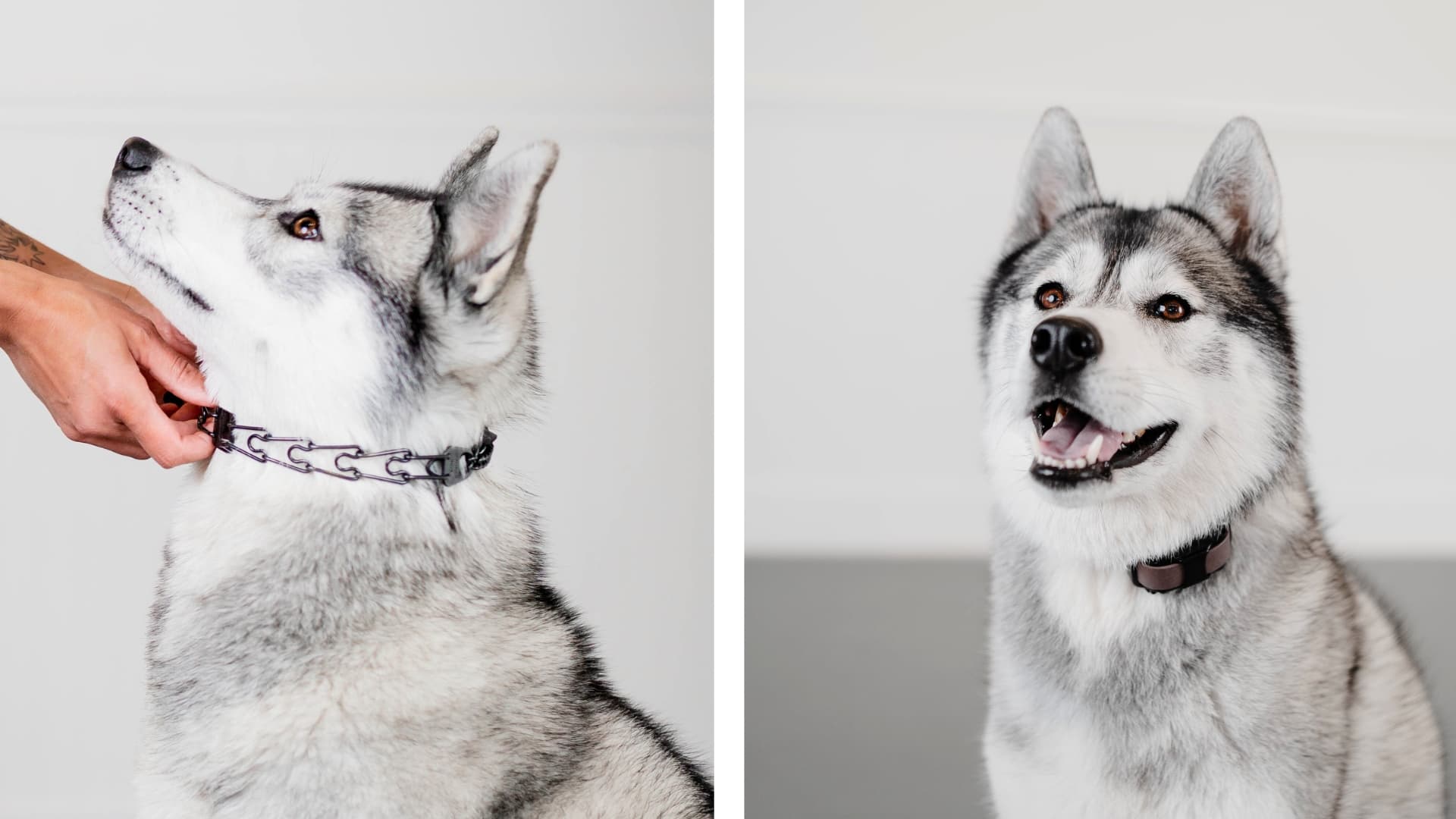
Quick Picks: Which Collar for Which Job
When dog owners ask me which tool to use, I match each tool to the job in front of them. The details on each one follow below.
| If you need | My pick | Why |
|---|---|---|
| Calm walks with a strong puller | Prong collar | The pressure comes on when your dog forges ahead and releases the instant they stop pulling, so there is a clear on and a clear off. |
| Reliable recall and off-leash control | E-collar | A remote reaches your dog at a distance, with 1 to 100 levels so you can find the lowest level your dog notices. |
| A dog that needs both jobs | Each tool for its own job | A prong collar for leash work and an e-collar for recall. Neither replaces the training underneath. |
Quick Comparison: How the Two Tools Differ
| Tool | Best for | How it communicates | Where it works | Fit |
|---|---|---|---|---|
| Prong collar | Pulling | Leash pressure that releases immediately | On leash, at close range | High, just behind the ears, snug |
| E-collar | Recall and off-leash work | Tone, vibration, or low-level stimulation from a remote | At a distance, from 1/3 mile to 1 mile on the models I recommend | Receiver snug against the neck, without pinching |
What Is an E-Collar?
An e-collar (electronic collar or remote collar) is a training device with a handheld remote and a receiver that sits on your dog's neck. It can give your dog a tone, a vibration, or a low-level stimulation, and the better collars let you choose from 1 to 100 levels. More levels means smaller steps between settings, which lets you discover the lowest level your dog notices. We call that the working level.
Used well, it is low level communication that works like a tap on the shoulder: a quiet reminder for a command your dog already knows, like recall, heel, or place. Your dog learns that the sensation switches off the instant they respond, and that is the whole communication loop. E-Collar Technologies is the brand I recommend more than any other. You can see my picks in The Best E-Collar for Dogs, or read What Is an E-Collar? for the full explanation. For the full step-by-step method, read my guide to e-collar training.
What an e-collar does best:
- Distance: it reaches your dog across a field or on a trail. E-collars can communicate from over 400 yards away, and the models I recommend range from 1/3 mile to 1 mile.
- Off-leash reinforcement: it supports recall and other known behaviors when there is no leash to help.
- Teamwork with rewards: it is layered over commands your dog already knows, taught with food, treats, and marker words, so your dog can focus on what you are asking.

What Is a Prong Collar?
A prong collar is a metal collar made of interlocking links, each with a blunted, inward-facing prong that rests against the dog's neck. When your dog pulls, there is tension on the leash and the collar tightens evenly around the neck. When the pulling stops, the pressure releases immediately. That pressure and release is the whole mechanism. Unlike a flat collar, which is perfect for ID tags and daily wear, a prong collar spreads the pressure evenly instead of loading onto one spot, so what your dog feels is clear tactile feedback: a clear on and a clear off.
As a trainer, I think of it as a communication tool, not a punishment device. It gives a gentle, consistent signal that interrupts the unwanted behavior, and the training around it teaches the behavior you want. Quality matters here. Herm Sprenger is the only brand I recommend, because the tips are smoothed, the links click together cleanly, and the steel lasts for years. You can read more in Prong Collar Training and Prong Collar Sizing.
What a prong collar does best:
- Clear leash communication: pressure when your dog forges ahead, release the moment they ease off.
- Strong dogs: for owners who have been dragged down the street for months, that clarity can be life changing, and for a strong dog and a committed handler it can turn a walk around fast.
- Close range: it works on the leash, which is why it belongs with heel work.
Control and Training Goals
The first question is not "which collar?" It is "what do I need my dog to do?" Calm manners and reliable recall are different goals, and each tool is built for one of them. Start with the behavior you want.
How Prong Collars Work for Strong Pullers
A prong collar is made for leash work. In trained hands it acts like power steering for a strong dog, turning small movements from you into clear signals whenever your dog pulls. A 2024 study published in PeerJ compared prong collars with other common walking tools and found the prong significantly reduced pulling, with no meaningful welfare difference between them.
It will not help with recall, and it works while there is tension on the leash, so pulling and heel work is where it belongs. A solid heel, built with calm, constant practice, keeps your dog's focus on you and takes the charge out of passing other dogs. For heel and loose leash manners, see the Loose Leash Walking Course and How to Stop Your Dog from Pulling on the Leash.
How E-Collars Perform for Recall and Off-Leash Work
E-collars are strongest where distance and distraction in the environment are the obstacle: recall in the real world, like on a hike, a dog who is far away in a field, or a command that gets lost in a busy park with other dogs around. A dog who has been practicing "come" for months has something solid for the collar to reinforce, because the behavior is already there. The goal is a dog who listens because they understand what you are asking, with the collar there as a backup. A large UK study funded by DEFRA found that e-collar and reward-based methods both improved recall and obedience, while the reward-based group showed fewer stress indicators for similar results, which is why the foundation is taught with rewards first.
If recall is your goal, start with How to Train a Dog to Come When Called, then see the Advanced E-Collar Recall Bundle or the Basic Voice Only Recall course.
LEASH TRAINING
Learn Loose-Leash Walking Step by Step
Natasha's course takes you from the first walk to a calm, loose leash, with the right tool introduced the right way.

Ease of Use and Learning Curve for Owners
Both tools are simple to put on, and each has its own techniques to learn. Neither is a tool dog owners should slap on and hope, so the learning is what makes the difference.
Using a Prong Collar Correctly
- Fit: place it properly, high on the neck, just behind the ears and under the jaw, snug with room for one finger underneath.
- Size: the 2.25 mm size generally covers dogs up to about 70 pounds, and you add links to size up.
- Safety backup: clip a slack backup from the prong to your dog's flat collar, which reduces the risk of your dog getting loose.
- Pressure and release: when your dog pulls, use a brief, gentle leash cue, release the moment they respond, and reward them with treats and praise, and never hold the cue constant.
- Training time only: it comes off when you are not actively training, for example during crating or sleeping.
Using an E-Collar Correctly
- Determine the working level: the lowest level your dog notices, then use it for low level communication over commands your dog already knows.
- Foundation first: your dog needs a clear marker word, an understood recall cue, and a clear idea of what a correct response earns.
- Fit: the receiver sits snug against the neck without pinching, with the contact points touching the skin, and the collar should be fully charged before a session.
- Tone or low stimulation: use it as a reminder for a behavior your dog knows, and stop the moment they respond. Adjust the level as the environment changes, for example from a quiet living room to a busy park.
Using Either Tool Well: Pros, Cons, and Honest Limits
No training tool is risk-free. Both e-collars and prong collars are aversive training tools, and the distinction that matters is not the category but whether the tool is applied with precision, timing, and clear communication. Both collars can impact a dog's emotional state differently, so I watch every dog's body language.
Prong collars can cause pain and potential injury to dogs when they are misused: a loose fit that rides low and pinches, cheap hardware with rough tips, constant pressure, or constant yanking. Both e-collars and prong collars require proper fitting to avoid injury, which is why I cover the fit in detail in Prong Collar Sizing.
Improper use of training collars can exacerbate fear in dogs, and shock collars can lead to physical problems and behavior issues when someone skips the introduction or defaults to high levels. Incorrect use of e-collars can lead to fear or anxiety in dogs, which is why the foundation, the gradual introduction, and the lowest level that works always come first.
The American Veterinary Society of Animal Behavior recommends reward-based training, and I agree that the reward foundation comes first. Every program I teach is built on it, with the collar layered on top.
Rules also vary by place. Wales banned e-collars in 2010, England proposed regulations in 2023, and several European countries restrict or ban them. Always confirm current rules where you live before you buy either tool.
Whichever tool you choose, the same training methods and habits make the difference.
- Foundation first is essential: teach your dog to understand what the cue means with food, treats, and marker words before any tool joins the picture, for example sit, down, come, and leave it. Short, happy sessions keep your dog focused.
- Buy quality: well-made equipment fits properly and behaves predictably, and it is not the place for owners to save twenty dollars.
- Read your dog's behavior: soft eyes, a loose body, and easy breathing mean it is going well. Wide eyes, a stiff body, a tucked tail, or freezing are signs of stress, so slow down and go back a step.
- Work toward needing it less: the goal is a dog who needs the tool less over time, or who simply keeps it as a backup.
- Reward the behavior you want: pair every cue with treats and praise, and let reward-based training methods carry most of the teaching.
- Get a second set of eyes: a trainer who knows the tool can check your fit, your timing, and your techniques.
If you want the full safety discussion for e-collars, my article Are E-Collars Safe for Dogs? covers it in detail.
E-COLLAR TRAINING
Ready to Learn How to Use an E-Collar?
Natasha's step-by-step e-collar course covers everything from foundation to off-leash recall.
E-Collar vs Prong Collar: Which Should You Choose?
The right tool depends on your dog, your goals, and how you want to train. Here is how I think about it, and why one tool or the other makes sense for each goal.
Choose a prong collar if:
- Your goal is calm, controlled walks with a strong dog and an end to pulling.
- You are ready to teach your dog what leash pressure means, ideally inside a structured training program like the Loose Leash Walking Course.
- You want clear leash communication without nagging or yanking.
Choose an e-collar if:
- Your goal is reliable recall and control at a distance, on trails, in fields, and in parks.
- Your dog already knows basic cues like come, sit, and place.
- You are ready to find your dog's working level and layer it over cues with rewards.
If your dog needs both, use each tool for its own job: the prong collar for pulling and heel work and the e-collar for recall. If your dog is too young for either tool yet, foundation training with food and marker words is the right place to start. If you are leaning toward an e-collar, see my picks in The Best E-Collar for Dogs, and for size-specific picks, small dogs and large dogs.

Final Thoughts
A prong collar and an e-collar are two ways for dog owners to have a clear conversation with their dog, one on the leash and one at a distance. Pick the one that matches your goal, teach your dog what it means with reward-based methods, and work toward needing it less.
FREE COURSE
Start With the Commands Before the Collar
The foundation your dog needs before any collar goes on: essential commands, at no cost.

Frequently Asked Questions About E-Collars vs Prong Collars
Is an e-collar the same as a shock collar?
People often use the words interchangeably, but a modern e-collar gives you a tone, a vibration, or a low-level stimulation, with 1 to 100 levels. At the low levels people actually train with, the sensation is closer to a muscle twitch or a tingle than anything you would call pain. See What Is an E-Collar? for the full explanation.
Which is better when my dog pulls on the leash?
When pulling is the problem with a strong dog, a prong collar is the tool I trust most. The pressure comes on when your dog forges ahead and releases the instant they ease off, so your dog gets a clear on and a clear off. See Prong Collar Training for the step-by-step method.
Which is better for recall?
An e-collar. It reaches your dog at a distance, which a leash cannot do, and it works best layered over a recall cue your dog already understands. The Advanced E-Collar Recall Bundle guides you through it.
What if my dog is too young for either tool?
Start with foundation training: sit, down, come, and leave it, taught with food luring and marker words. A well-fitted martingale collar or slip harness gives fair, even communication in the meantime, and a long line, around 20 to 30 feet, gives a taste of off-leash freedom while keeping your safety net. See my puppy guide and Why Marker Training Dramatically Speeds Up Your Dog's Learning.
Can I use these tools with an aggressive dog?
If your dog shows unresolved fear, extreme anxiety, or aggression, I would bring in a qualified behavior professional before adding either tool. A dog who is working through fear needs a plan built around that fear first, and a professional helps keep the whole process clear and low stress.
Will my dog need to wear the collar forever?
The goal is to need the tool less as your dog's behavior becomes reliable. Plenty of dogs happily wear a prong collar for life, and that is fine. With an e-collar, the aim is a dog who listens because they understand what you are asking, with the collar there as a backup.
Do I need a trainer?
Both tools work best inside a structured training program or with a trainer who knows the tool. That is why I teach them inside courses, so owners can learn each tool step by step: the Loose Leash course for the prong collar and the Advanced E-Collar Recall Bundle for the e-collar.
Natasha Johnson
Founder & Head Trainer