E-Collar Training
Best Shock Collar for Small Dogs: A Trainer's E-Collar Picks
By Natasha Johnson, Founder & Head Trainer
Short answer
For most small dogs, get the E-Collar Technologies Micro Educator ME-300, rated for dogs 5 lbs and up with the lightest receiver of my picks. If your dog is on the bigger side of small, step up to the Mini Educator ET-300.
What You'll Learn
- Which e-collar suits a small dog, and from what weight
- How to check receiver size, contact points, and fit on a small neck
- Why cheap imported shock collars are a risk for smaller dogs
- How to start safely, and when a small dog can begin
Quick Picks: The Best Dog E-Collar Options for Smaller Dogs
These are my picks for smaller dogs among dog training collars. The details on each model follow below.
| If you need | My pick | Why |
|---|---|---|
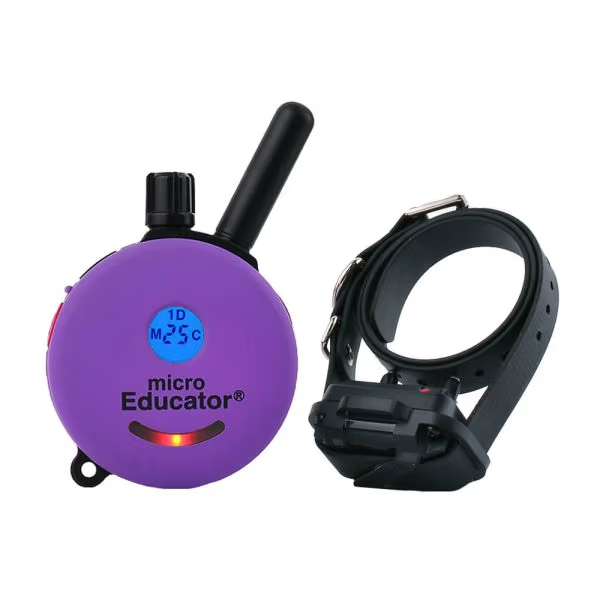
| Best for most smaller dogs | E-Collar Technologies Micro Educator ME-300 | The lightest, most compact receiver of the collars I recommend, rated for dogs 5 lbs and up, with stimulation about 20% gentler than the Mini Educator. |
| Best all-round collar for smaller dogs | E-Collar Technologies Mini Educator ET-300 | Also rated for dogs 5 lbs and up, with 100 levels, a 1/2 mile range, and the most user-friendly remote. |
| Best for a small dog 10 lbs and up, or two dogs | Dogtra 280X | 100 levels, a 1/2 mile range, and a physical toggle that switches between dogs on one remote. |
None of the training collars I recommend is rated for dogs under 5 lbs. If your dog is smaller than that, wait until your furry friend is bigger and focus on foundation training in the meantime.
Quick Comparison: Weight Rating, Range, Levels, and Receiver Weight
| Collar | Dog weight rating | Range | Levels | Receiver weight |
|---|---|---|---|---|
| Micro Educator ME-300 | 5 lbs and up | 1/3 mile | 100 | about 2 oz |
| Mini Educator ET-300 | 5 lbs and up | 1/2 mile | 100 | 2.4 oz |
| Dogtra 280X | 10 lbs and up | 1/2 mile | 100 | 2.4 oz |
Specs come from the E-Collar Technologies and Dogtra product pages, checked in October 2026. Always confirm the rating for your own dog before you buy.
Why This Collar Choice Matters More for This Size of Dog
Choosing a shock collar for a small dog is not the same as choosing one for a Lab. An e-collar is an electronic dog training collar, and a 10-pound Chihuahua and an 80-pound Lab can both wear one, but the size of the receiver, the fit of the contact points, and how finely you can control the stimulation all matter far more on smaller dogs. A dog e-collar that works well on larger dogs can be the wrong tool for a small one.
I have trained dogs with e-collars for more than ten years, and when owners of smaller dogs ask me which e-collar to buy, my answer comes down to three things: a collar that is specifically rated for smaller dogs, a receiver that is light and compact, and enough stimulation levels to find a gentle working level. This guide covers the remote training collars I recommend for smaller dogs, the dog training collars worth your money, how to choose between them, and why I tell owners to stay away from cheap imported shock collars.
What Makes Dog Training Collars Right for Smaller Dogs?
Smaller dogs have lower body weights and can have more sensitive skin than larger breeds, which is why the details of the collar matter so much. Shopping for an e-collar for smaller dogs is mostly about fit and control. Here is what I check before I recommend any of the dog training collars on the market for a small breed. These training collars can all work, but only if the rating, the receiver, and the fit are right for your dog.
A Weight Rating for Smaller Dogs
Assess your dog's weight and behavior to choose the right collar, and whatever you do, steer clear of any e-collar that is not specifically rated for smaller dogs. Contact point spacing and receiver size genuinely matter for a proper fit and safe stimulation on a smaller frame. The three training collars in this guide are rated for dogs from 5 lbs (ME-300 and ET-300) and 10 lbs (Dogtra 280X) and up, which is why I trust them for smaller dogs.
Receiver Size and Weight
The receiver is the part of the e-collar that sits on your dog's neck, so on smaller dogs its size and weight matter. A heavy receiver collar on your furry friend's neck is uncomfortable and can shift out of position. The ME-300 has the lightest, most compact receiver of the collars I recommend, at about 2 ounces, compared with about 2.4 ounces for both the Mini Educator and the Dogtra 280X, which is why it is my first choice for the smallest dogs. Check the receiver dimensions before you buy and compare them with your dog's neck.
Contact Points and Collar Straps: Where Better Dog Training Results Start
The contact points are the two small metal posts on the receiver that rest against your dog's skin and deliver the stimulation. Smaller dogs have a smaller neck, so the contact points need to sit right where the receiver rests. If the contact points do not touch the skin, your dog will not feel a consistent signal, and if the collar is too tight, it is uncomfortable. A correct fit means the contact points stay against the skin and the collar sits snug without squeezing your dog's neck. On a small dog, check the fit often, because a loose receiver rolls around easily. A dog with long hair or a thick coat may need extra care to keep the contact points in the right place. Collar straps should be sized for a smaller neck, so measure your dog's neck for proper collar sizing and make sure the strap fits your dog before you start training. Remove the collar after each training session, because a collar left on for extended periods, especially on a dog who is active or wet, creates the conditions for skin injury. Follow your manufacturer's guidance on wear time too. Dogtra, for example, says e-collars should typically be used for no more than 12 hours per day, and should be removed at night and during rest.
Stimulation Levels
Stimulation levels matter even more on a small dog. More levels means smaller steps between settings, so you can fine-tune the signal and find the lowest level your dog notices, often called the working level. Take your time to find your dog's level, and remember that the right level depends on your dog's specific temperament. For anyone doing nuanced obedience or recall, 100 levels is the minimum. Fewer than that and you will struggle to find your dog's true working level, which means you will likely be working your dog at levels that are too low or too high. Both E-Collar Technologies and Dogtra offer 100 levels. On smaller dogs, that precision is what keeps the collar comfortable, and it is the biggest difference between quality training collars and the cheap ones.
Range and Waterproofing
Match the range to what you will actually do. For a small dog in the yard or at the park, a 1/3 mile or 1/2 mile range is plenty. The collar and the remote should both be waterproof, because dogs do not stay dry and training sessions do not wait for good weather.
E-Collar Technologies: My Top Pick for Smaller Dogs
E-Collar Technologies is the brand I recommend more than any other among dog training collars, and it is the one I keep coming back to for smaller dogs. I love the simplicity of the remote, they have good customer service and stand behind their collars, and the collars are made in the USA, and the blunt stimulation technology combined with 100 levels lets me fine-tune my communication with my dogs. If you are curious about the brand, I explain more in my guide to the best e-collar for dog training.
Micro Educator ME-300: Best for Small Dogs
The E-Collar Technologies Micro Educator ME-300 is my top choice for smaller dogs. It is rated for dogs from 5 lbs and up, with a 1/3 mile range. The receiver weighs about 2 ounces and is more compact and lightweight than the Mini Educator receiver, which makes it a perfect option for littles. Its stimulation is also about 20% gentler than the Mini Educator, which suits small and sensitive dogs.
Key benefits of the ME-300: the lightest receiver of the three collars, gentler stimulation, and a 1/3 mile range that is plenty for a yard or a park.
The ME-300 is the right choice if your dog is at the small end of the range of smaller dogs, if your dog is sensitive, or if you want the lightest receiver on the neck.
Mini Educator ET-300: Best All-Round Collar
The Mini Educator ET-300 is the most widely used training e-collar in the world among professional trainers and serious hobbyists, and it is the collar I have trusted with my clients' dogs for over a decade. It is also rated for dogs 5 lbs and up, with a 1/2 mile range, and it has 100 levels. For most owners of smaller dogs, it is the collar to buy: it is compact, reliable, and it does everything you need for basic obedience and recall. At around $199, it is one of the most affordable collars from a quality brand.
So which should you choose? Both the ME-300 and the Mini Educator ET-300 can be used for dogs as small as 5 lbs. The ME-300 is better for the smallest dogs because the receiver is lighter and smaller. If your dog is a little bigger, or you want the longer range, the ET-300 is the one I reach for first. The ME-300 is a low power unit, while the Mini Educator is a low to medium power unit, so choose the lower one for the most sensitive dogs. For small dogs with normal temperaments, the ET-300 is plenty. Either way, the Mini Educator circular remote sits in your palm, with your thumb resting comfortably over the tone and vibration button and your pointer and middle fingers resting directly over the two stimulation buttons. A blue backlit LCD screen shows your level, the remote floats, and the Mini Educator also comes with a belt clip option. Its ergonomic no look design and the Lock and Set feature, which saves your level to a button, make no look operation easy, so you do not have to glance down at the remote. Other key benefits of the ET-300 are the longer range and the 100 levels.
Blunt Pulse Stimulation
E-Collar Technologies uses its own Blunt Pulse technology for static stimulation, which delivers a rounder, smoother sensation than the sharper pulse you will feel from some other brands. Most dogs habituate to it quickly and respond to it calmly, with far less of the little startle response a sharper pulse can sometimes trigger. That is a real advantage on a sensitive small dog, and it is one reason I like the Mini Educator and the ME-300 for smaller dogs.
Dogtra 280X for Small Dogs
Dogtra has been making e-collars since 1979 and is one of the few other brands I trust, and the 280X is the newest version of their long-running 280C. It is the Dogtra I recommend most. It has 100 levels, a 1/2 mile range, and it is rated for dogs 10 lbs and up, so it suits one of the smaller dogs that is on the bigger side of small. Dogtra lists a minimum neck size of 7 inches for the 280X, so measure your dog's neck before you buy, and it is also a good step up if you have larger dogs in the house as well.
The 280X is also my pick when I am working two dogs at once. It can expand to three dogs on one remote, which is a big help for households with several dogs, and you switch between them with a physical toggle. You flip the switch and the same buttons now control the other dog, which you can do by feel without taking your eyes off the dogs. If you have two dogs, or you plan to add a second one later, that makes a busy session much easier. Dogtra and Mini Educator training collars work very much alike in everyday training, so choosing between them mostly comes down to fit, feel, and how you plan to use the collar.
E-COLLAR TRAINING
Ready to Learn How to Use an E-Collar?
Natasha's step-by-step e-collar course covers everything from foundation to off-leash recall.

Why I Say No to Cheap Imported Shock Collars
If you search for a shock collar for small dogs, you will see dozens of cheap imported collars with a small-dog label. The market is flooded with them, from brands that have no training heritage, no consistency, and no one to call when something breaks. Many of these brands rely on a handful of big steps instead of fine control. Please do not go buy a random, cheap collar off of Amazon. On smaller dogs, a poorly made collar can do real harm. They are not worth the risk. Here is what goes wrong:
- Too few stimulation levels, often just 3 to 5, which makes finding a true working level for your individual dog nearly impossible.
- Inconsistent output, so the same level can feel different every time you press the button. Inconsistent stimulation levels destroy the predictability your dog responds to and depends on to learn.
- Poor waterproofing.
- No support and no real warranty for the day something goes wrong.
The dog training collars I recommend are not the cheapest ones you can find, but they are the only ones I trust with my own dogs, and that is the bar I would want you using too.
What Does an E-Collar Feel Like on Smaller Dogs?
It depends on the level. At the lowest level your dog notices, the goal is a signal your dog can recognize and respond to calmly. For most dogs, the first sign is small, such as a flick of the ear or a turn of the head. At a working level, the sensation is often compared to a TENS machine, the unit physical therapists use, and quality training collars deliver static stimulation in small steps. It is noticeable and attention-getting, a little uncomfortable, but not the dramatic pain the name implies. That is why 100 levels matter so much on smaller dogs: they let you find the gentlest level that works, and the way your dog responds tells you whether you have it right.
An e-collar can also use a tone or a vibration on its own. Vibration here is a non-stimulating vibration, the buzz of the receiver, not electrical stimulation, and it can be a helpful way to get your dog's attention, depending on the model. A vibration collar is a separate device that produces physical vibration through a motor, with no electric shock at all.
How to Start Dog Training With an E-Collar and a Small Dog
Do not start with the collar. Start with a dog who already understands what you are asking. At the beginning, teach each command on leash with markers and rewards, then add the e-collar as a layer so the signal means something to your dog. Use positive reinforcement when you introduce the collar as well, and keep the whole process reward-based. A dog who has never learned what come means cannot learn it from a collar, because there is nothing to build on. Basic obedience training comes first, and it makes everything after it easier. This is exactly what my Voice Only Recall Course teaches, and the E-Collar Recall Course walks you through the next steps, including how to introduce the stimulation and find your dog's working level.
When can a small dog start? For most owners, I do not recommend using an e-collar on a puppy younger than 7 months, and I would rather most people wait until their dog is about a year old. Foundation training can start the day you bring a puppy home, and I cover the full answer in Can You Use a Shock Collar on a Puppy?
As the training sinks in, your dog should need the collar less and less. That is the goal: a dog who listens because they understand what you are asking, with the collar there as a backup. For a closer look at the safety questions, read Are E-Collars Safe for Dogs?, and if you want to understand how these collars work, start with What Is an E-Collar? For the full step-by-step method, read my guide to e-collar training.
GET THE FREE PLAN
Want a Free Recall Plan Built for Your Dog?
Get our free Recall Starter Plan, customized to your dog.
Choosing Between the ME-300, the ET-300, and the Dogtra 280X
If you are still deciding, here is how I would choose among these dog training collars for smaller dogs:
- Pick the Micro Educator ME-300 for the smallest dogs, for sensitive dogs, or when you want the lightest receiver collar on the neck.
- Pick the Mini Educator ET-300 if your dog is a little bigger, if you want the longer 1/2 mile range, or if you want the e-collar I recommend most.
- Pick the Dogtra 280X if your dog is 10 lbs and up, or if you work two dogs and want to switch between them with one remote.
Whichever you choose, the Mini Educator and the ME-300 come from the same company, so the remotes and the way you use them are very similar. That makes it simple to move from one to the other if your dog grows or you add a second dog.
If You Also Have Big Dogs
If you also have big dogs at home, the Boss Educator ET-800 is the one I recommend for dogs 25 lbs and up, so you can keep the same brand across your household. For my full guide to larger dogs, read Best Shock Collar for Large Dogs.
Common Mistakes With E-Collars on Smaller Dogs
Most problems I see with smaller dogs come from the same few mistakes, and owners often make the same mistake twice, so here is what to avoid:
- Buying a training collar that is not rated for your dog's weight, or one that was made for larger dogs with a strap shortened to fit.
- Buying a cheap imported training collar with only a handful of levels, so there is no gentle working level to find.
- Skipping the foundation. The e-collar is a layer on top of commands your dog already knows, and obedience training and verbal commands come first.
- Starting at a level that is too high instead of finding the lowest level your dog notices.
- Using a collar to fix leash pulling. If your small dog's problem is leash pulling, start with leash training, not a remote collar.
- Forgetting to check the fit. A collar that is too loose gives an inconsistent signal, and one that is too tight is uncomfortable, so check the contact points and the collar straps often.
If you need GPS tracking, for example for a small bird dog that hunts, that is a different job from everyday training, and I only recommend Garmin for hunting dogs. For everyday obedience and recall, the three models above are the ones I would put on your dog.
Bark Collars Are a Different Tool
This guide covers remote training collars. Bark collars are a different tool, built to interrupt barking, and automatic bark collars carry a risk of false corrections, because the timing can misfire and your dog cannot always make a clear association. Many of them sense the vibration of your dog's vocal cords. A bark collar will not solve leash pulling or recall either, and neither does an e-collar on its own. I do not recommend a bark collar model here. If barking issues are the problem, start by working out why your dog is barking, and treat bark collars as a last step, not a first one. The same goes for an invisible fence: an invisible fence collar keeps a dog inside a boundary, which is a different job from the communication a remote training collar provides, and an invisible fence is not covered here.
FREE COURSE
Start With the Commands Before the Collar
The foundation your dog needs before the collar goes on: essential commands, at no cost.
Frequently Asked Questions
Is a shock collar safe for small dogs?
Any tool can hurt a dog when it is used badly, and that is especially true for smaller dogs. A collar that is rated for your dog's weight, a low working level, and a solid foundation are what make the difference. I go through the evidence in detail in Are E-Collars Safe for Dogs? If your own vet or a veterinary behaviorist has assessed your dog and advised against an e-collar, take that advice seriously. Veterinary behavior organizations, including the American Veterinary Society of Animal Behavior, advise against these tools as a first-line approach and prioritize reward-based training, and I agree that reward-based training is the right place to start. If your dog has any throat or neck health issues, check with your vet before using any collar.
Can you put a shock collar on a 10-pound dog?
Yes, if the collar is rated for it. The ME-300 and the Mini Educator ET-300 are rated for dogs 5 lbs and up, and the Dogtra 280X for dogs 10 lbs and up. Among training collars, the rating matters more than anything else on the box, so check it before you buy, and make sure the rating fits both small dogs and any bigger dogs in your home.
What is the smallest shock collar I recommend?
Of the e-collars I recommend, the Micro Educator ME-300 has the smallest, lightest receiver, at about 2 ounces, a little smaller and lighter than the Mini Educator.
Is a vibration collar better than a shock collar?
They are different devices. A vibration collar produces physical vibration through a motor, with no electrical stimulation. Many e-collars also include a vibration mode and a tone that you can use on their own, depending on the model, so you get both options in one collar.
At what age can a small dog start e-collar training?
I do not recommend using an e-collar on a puppy younger than 7 months, and I would rather most people wait until their dog is about a year old. Foundation training, including basic commands, can start the day you bring your puppy home, and it is the same for small dogs and bigger dogs.
Which brand is best for smaller dogs?
E-Collar Technologies is the brand I recommend more than any other, and the Micro Educator ME-300 and the Mini Educator ET-300 are the two collars I reach for with smaller dogs. Dogtra is the other brand I trust, with the 280X for dogs 10 lbs and up. I only recommend Garmin for hunting dogs.
Do small dogs need a different stimulation level than larger dogs?
Every dog has an individual working level, so size alone does not decide it. A smaller dog often does better with a gentler collar, which is why I like the ME-300 for the smallest dogs, but the goal is always the same: the lowest level your dog notices, used as clear communication.
Which e-collar should I buy for my small dog?
The best dog e-collar for most small dogs is the E-Collar Technologies Micro Educator ME-300. If your dog is a little bigger, the Mini Educator ET-300 is the all-round collar I trust most, and the Dogtra 280X suits dogs 10 lbs and up and households with two dogs. See The Best E-Collar for Dogs for my picks by brand.
Natasha Johnson
Founder & Head Trainer